Commons Sense
Trying to make sense of it all in education
So I have spent a few minutes using some infographic resume sites which all pull data from my own personal linkdin site. Let me share the initial outcomes

Spoken language map from visualize.me
1) visualize.me
Here is my personal infographic resume from this site – http://vizualize.me/neilcommons?r=neilcommons
This is my favourite of the three offerings. I like the timeline representing my educational and working lifetimes in parallel. My interests, and crucially the scaling of them is fascinating. As seen on the diagram when my own limited language skills are represented on a world map they seem far more impressive than they really are.

Skills and specialty proficiency from cvgram.me
2) cvgram.me
Here is my personal infographic resume from this site – http://cvgram.me/neilcommons
I think that there is a great deal of interesting extracted information but the proficiency and frequency of use source information presently does not well reflect me. For instance the statement of having only one year of science skills does not well represent my life time of scientific pursuit. In fact it only reflects when I updated linkdin so I need to look at how I can change that information.

Employment timeline from re.vu
3) re.vu
Here is my personal infographic resume from this site – http://re.vu/neilcommons
There is just not enough information on this site. There is only a employment timeline and two large icons showing my university qualifications. So simply there is just not enough information there to justify it’s existence.
So, as I mentioned before, I instantly warm to the visualize.me version and feel it reflects me the most – and considering that they all come from the same information this really does emphasise the power of visual representation. For me I felt they effectively highlighted the gaps. For instance there was no reflection of my voluntary history which I feel represents a large part of my life so this needs to be somehow rectified.
So to wrap up I am going to recognise the power of infographics they promote an emotive response to information and when we are talking about trying to get someone to give you a job this can only be a good thing – if done correctly.
Do I think these tools are great – yes. Am I glad that I am not presently looking for a job and have at least a year to work on these – yes. So will I be using these tools to help me get my next job – BIG YES.
So I have started to evaluate the digital gateways which I create for my students. This post explains how my journey went and why I made the alterations that I did. Yet I have to admit to a feeling that I have only just scratched the surface and really need to consider more research based information on this topic.
In 1997 Jakob Neilson first wrote about “How user’s on the web” and clear stated the requirements for a scan able text which should be represented on the web as having:
Now in the context of school I am not required to produce a true website but I do use our intranet (the portal) as the gateway to teaching and learning resources for my students for each unit of work I teach. I do very much see these to be act like the contents page of the units book and have endeavoured to keep them as such uncluttered and effective.

My old car safety unit portal page
A basic structure would be 1) a title followed by some additional useful additional links, 2) A list of assessment tasks, and 3) A table breaking down the content into topics and the related resources.
So now I need to reflect upon this format with respect to the student. Does the typical student really care about the additional websites and options that I identified? Now even if a student was interested in these hyperlinks it would still not be an every lesson occurrence so clearly these need to be moved further down the page. What students care about is what do I have to do now – lesson content – and what am I going to be assessed on. So I am going to bring the lesson content table up and follow that by the assessment tasks. Considering my audience is a digital generation I am less concerned that to access those additional resources will involve some additional scrolling especially if I can use this model with all my classes.
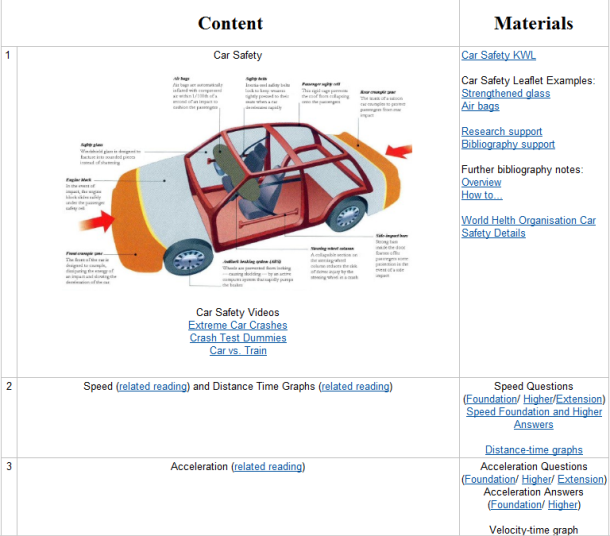
My old portal content
Now I look at the more subtle features. Typeface can be used to highlight points so in turn this means consistency in typeface is important. I read an article about “Which fonts do children prefer to read online?” which shows that research indicates comic script. Yet this is not an option within the editing page for the portal so I just set everything on Arial font. I was also informed that a font size of 14 is also preferable and again this is not a built in option. So the bulk of the text is set at font size 12. I do recognise that with a bit of cut and pasting I could fix both of those problems but that really does not feel like a good use of my time. The sub-levels in my contents table are all meaningful as they highlight the relevant topic. Yet I can improve on this by setting them in bold and aligning them to the left. I have also removed all underlining – using font size or bold – to highlight points and to save confusion with hyperlinked options.
I also spot the opportunity to consolidate my key learning objectives with visual prompts under each of these topic headings. Is this beneficial for my students? I have to do some more research on this feature.
So I have tweaked my first portal page with a greater consideration for my audience. I will endeavour to adjust all my portal pages with the student in mind. I wander if anyone will notice? And feel that an even bigger change is required.

New portal structure
I have been working with a team of other NIST teacher on updating our acceptable use policy. It is hoped that this version will be put forward to the school’s SMT ready for the next academic year.
NIST proposed Student Acceptable Use Agreement
Following the related discussions the group began to consider how the ideas embedded within the AUP could be more effectively shared with students. Jago and Adrian really led the way in the creation of a more visual interpretation:

bullying-739607 by Chesi – Fotos CC
Attribution-ShareAlike License
“I shall not today attempt further to define the kinds of material I understand to be embraced within that shorthand description [“hard-core pornography”]; and perhaps I could never succeed in intelligibly doing so. But I know it when I see it, and the motion picture involved in this case is not that.” —Justice Potter Stewart, concurring opinion in Jacobellis v. Ohio, regarding possible obscenity in The Lovers.
Like pornography, what is cyber bullying is itself subjective and lacks clearly defined parameters. The U.S.A. based site, stopcyberbullying.org states “Cyber bullying” is when a child, preteen or teen is tormented, threatened, harassed, humiliated, embarrassed or otherwise targeted by another child, preteen or teen using the Internet, interactive and digital technologies or mobile phones.”
My own school uses the simple statement in the secondary laptop use agreement of “Don’t do bad things”. Now I recognise that this statement is vague enough to capture a range of actions but undoubtedly within that net is cyber bullying. As a guideline to what a bad thing could it would seem sensible to cross reference our own disciplinary procedure. Under Step 2, which is described as not behaving responsibly, cyber bullying has been clearly highlighted. So the dots are joined between abstract policy statements.
Yet abstract policy statements do not equate to everyday practice, they certainly do not help a student who is being cyber bullied and as a teacher I am not aware of either a related procedure or the underlying issues which have driven it. Now before people misinterpret what I am saying let me make it clear that I honestly believe that my school would respond to (and undoubtedly does) such issues in a fair and considered manner. Yet what I am also stating is that at present the bigger picture has not been addressed.
The Scottish based anti-bullying site respectme.org.uk suggests some important elements of practice which need to be in place to combat bullying:
1) Culture
An organisation’s culture should make it clear that bullying is never acceptable and support all adults and children and young people in achieving this ethos.
My thoughts: The opportunities to address and highlight the issues of cyber bullying only appears as a session during the year 7 tech conference day which they attend upon receiving their laptops for the first time. The need for the issue to be explicitly addressed and at different year levels to empahsize both consistency and more advance intricacies that will come as the students become older. This should be aligned with the ideas of each student’s growth as a digital citizen and what responsibilities come with that role. This also provides a route to consider our students beyond the confines of the school grounds.
2) Practice
Day to day practices should reflect the message that bullying is never acceptable and should be continuously reinforced in all the work that you do.
My thoughts: The effective implementation of a clearer procedure of practice to all staff should use role play scenarios. This would provide staff with an exposure of a range of situations and encourage through discussion an informed alignment in response to these issues. This implementation should also provide an opportunity for the issues discussed with students to be further disseminated with staff. All of which opens up the opportunity for a continued conversation with students when those magical teachable moments occur.
3) Response
Responses when dealing with children and young people who are involved in bullying incidents is vitally important. The response should be consistent, regardless of whom the child or young person approaches.
My thoughts: The details of the response should be more closely considered. The abstract behaviour policy at present does not reflect an opportunity for meaningful peer mediation. Also an anonymous forum or tip off location could be offered where students can highlight examples of cyber bullying for the school to deal with and to further empower those bullied students.
With these elements as a starting point I am going to add my own ideas and then will work with my own pastoral role (I am a house leader – go blue house) to move this issue forward. I will let you know how this goes.
 The independent learning element of the flipped classroom and the formative assessment element of mastery are features which may cause alarm in certain cultures (this word can, and should, be interpreted in many ways here). So when some of my students started showing interest in moving to another science option I was not completely surprised by these thoughts. I immediately asked for a meeting with my own admin team (whom I am quite sure also wanted to speak to me about this issue). I admit that I did have an unjustified niggling fear that at the culmination of this meeting I would be asked to go back to the old ways. Yet I also recognise that my school has always been supportive of innovative educational processes as long as it is well considered and has the best outcome for the students at the core. As people who have read this blog previously I hope it has been made clear that I really do believe in the pedagogical benefits of the flipped classroom. As it turns out my admin were determined to find out about what was actually going on in my classroom and having clarified carefully considered steps towards finding a solution which would help move everyone forward.
This whole process has made me reflect on the process from both my own perspective and that of my students which I hope will be beneficial to all. However the underlying message of this post is that we should always take the opportunity to pay thanks to those people who support good education practice even if it is not the norm. Thank you my admin team.
Now I need to go back in time a few days to the moment I received an e-mail from admin informing me that 3 members of my standard level physics class are considering switching to biology. A panic set in and I started to reflect on my own notes from the class
1) I got my first clear feedback about a video I had set for viewing, the feedback was a student found the accent difficult to use. This is a good sign indicating involvement in the process and will stimulate the production of my first own video (more about this in the future)
2) One student has not completed any of the mastery questions and several seem to have got stuck on the basic speed and acceleration questions. I really need to make it clear that there is not a requirement to complete these tasks sequentially and in reality they have two years to reach mastery in all areas. I will contact those students and recommend attending my after-school support session on Thursday’s.
3) Students had shown concerns about finding time to complete internal assessment (IA) work. I need to help students appreciate that IA runs parallel to the course and students can manage their own time to complete tasks but must remember that doing it promptly keeps it fresh in their minds.
The students in question arranged to visit the biology class for a lesson and the teacher very supportively made an effort to interview the students who were considering moving classes to get to the route of their motivation. The key points made were:
1) They like physics but are concerned about the future demands of the course
2) They are unsure as to how the increased pressure from other classes would impact the requirements of the flipped classroom (e.g. future time management issues)
He also noted that Biology and Physics are very different sciences with knowledge retention at the heart of Biology and problem solving at the heart of Physics.
Before meeting with my admin team, I further analysed the situation and felt some further issues were at play:
1) Students are not used to the expectations of independent learning
2) The acceptance of failure in achieving mastery is a new experience for many
3) The initial topic of mechanics does not initially contain that much new content so students will not be able to fully appreciate the learning benefits of this process
The outcome: An open discussion facilitated by admin took place in my class to help both sides better understand their own learning needs. From this I will now be better supporting my students by:
1) Creating a required learning checklist, which I will create from the course syllabus, to support each stage of independent learning
2) End each lesson with further instructions on what is required from the next stage of independent learning
3) Start each lesson with a few minutes discussing any issues which arose from the independent learning to help recreate the group element of learning which some felt they missed.
So I will put these ideas into practice and will keep you all informed about my own trails and tribulations with the flipped classroom.
Who does not want an easy life, the path of least resistance. Passive lecture style lessons provides that opportunity. A flipped classroom situation demands student involvement to succeed. Yet to actually succeed in a lecture style requires student involvement as well. The flipped classroom is designed to be more student centered and for (potentially many) different learning paths to be found that reflect the learning styles of those students.
 These are the internal arguments that I have been having and I recognise that the success of a truly student centered classroom lies with the motivation of the students. So this has to be a key consideration. I am in a good place though, I know most of the class from previous teaching experience and the ones I have not taught before are new to the school. So I open with absolute honesty and in my first lesson I explain the concepts of the flipped classroom. I even show them the Sal Khan video “How video can reinvent education“. To get the class reflecting on their own preferred learning styles I use the great “How do you learn?” website.
The first actual Physics concept which my standard level Physics class is uncertainty. A topic which undoubtedly resonates with my own worries. I have identified a number of choice tools to consolidate their understanding and simultaneously experience the essence of the flipped classroom. Whilst in class it is all hands on where we consolidate with an activity calculating density. This works my one note to self is that I have to be really careful about the use of consistent terminology in videos.
As we move forward I introduce my expectation that there is a need for evidence that you have indeed attended the flipped class outside of mine. I ask to see notes relating to the key points which have been covered. I explain that my intention is to promote the transfer of knowledge to consolidate understanding and this is also the evidence which will inform my own mark book. The need for them to enter my classroom prepared to face questioning and discussion of misconceptions on what they should have covered outside the classroom.
The next couple of lessons seem to go well – all of the class having reviewed the content – although in reality much of this is a review of knowledge covered previously. Then comes two lessons one day after the next and about 30 seconds into my starting knowledge review questions and it is clear that most of the class have not been able to manage their time effectively enough to be ready for this lesson. For those that have I set up a table and support them through some consolidation questions. For those that have not done anything I have a quick word and then shift their lesson task to a practical which was already in place – this is the joy of many paths, there is always something constructive to do.
I am happy with the internal mechanics of a flipped classroom and as I have discussed elsewhere I am working on helping the students recognise that this is a powerful tool for their education. My second greatest fear is a parental backlash. So I decided to go on the offensive and take the concept to the parents.
The parents (specific to class)
I wanted to the parents of my standard level Physics class to be well informed about the different teaching and learning strategy being utilised in my classroom. Furthermore, I wanted them to appreciate that this method has their sons or daughters at the heart but that this also requires for them to take on this responsibility. I also felt by opening up the mastery records page on the school portal it provides a useful insight for parents with respect to their child’s progression (and having a mother/father be able to monitor and push/ motivate my students to get stuff done is no bad thing either). With this in mind I sent the following letter to the relevant parents.
Flipped Classroom Introduction
As it happens I have yet to have any responses. I am not sure if this indicates that I was successfully clear and informative or that the parents are just not that worried. Either way I felt it was the right start to any further conversations I might have to have with certain parents.
Parents (in general)
At my request “Learning styles and the flipped classroom” was added to the back to school night presentation night. Now I recognise that this is not the most rock n’ roll of session titles – not including words such as exceptional learner or advice on how to handle a teenager. With this in mind I expected at most 4 or 5 people to each of my two sessions. As it turns out I had 16+ people in both sessions (more than the exceptional learner sessions which I expected to be a sell out but not as much as “mathematics in the context of NIST” which turned out to be a surprise draw.
You can take a look at the related prezi – Learning styles and the flipped classroom (if you are that kind of learner) but as I have not added a live audio soundtrack I will try and explain the different phases of the presentation.
Phase 1 – Introduction and self reflection
Having introduced myself I started the session by asking participants to identify their own preferred learning style from visual, auditory and kinaesthetic and to sit at an allocated table. I commented that it was interesting how everyone had aligned themselves into the allocated boxes in such a quiet orderly fashion. Maybe it was that as adults they are now really aware of what is their preferred learning style or maybe the situation did not provide an opportunity for discussion. However, I felt that no one here had completely done themselves justice by sitting in a box and that in reality a map of the learning styles which best work for each individual would actually be a constantly evolving (dependent on a number of external factors) 3D shape.

Phase 2 – Our students are wise
I explained that I had recently asked a similar question to my year 11 science class who were about to start a teaching to learn unit on waves and that the response was fascinating. I was able to sit back and am taken back at the various nuances they discuss. Our students are aware of how best they learn and one of the key reasons for this is that the MYP has approaches to learning at its heart. Which in turn prepares our students for the increased demands of the IB Diploma.
Phase 3 – How you and I learnt maybe did not perfectly work for us
Considering the preferred learning styles we have each identified how did they suite an academic lecture situation?
Phase 4 – There is a new way
To emphasize the fact that, through the internet, we have now have access to great educational resources I show the Sal Khan TED Talk, “Let’s use video to reinvent education”, which both explains the ideas of the flipped classroom and the ideas of mastery.
Phase 5 – My classroom
I explain how I have set up my own classroom – a typical classroom with students interacting (and with me focused on student support) but with an additional set of resources available through the class portal site designed to help all the learners present.
Phase 6 – Mastery
Mastery will be displayed in my own class using the excellent Mind on Physics resource and is designed to help students identify where they need greater support from me and keep track of their own progression within the class itself.
Phase 7 – Know your child and help them know themselves
Talk to your child about their learning styles and what they study at school. If they can do this then it is a great start. If not then they may need your help on this journey.
Again the feedback from parents was positive but in a way that appeared they were more pleased to be let inside how different types of teaching and learning are taking place.
I think that both of the steps – the introductory letter and the back to school night presentation – have helped keep the parental community informed. I think it is surprises which people respond badly to, so with that in mind I am happy that I have taken the chance to plant some seeds.
NIST Radio is the school radio station that I am working with students to bring to life. In my past it was radio that launched a brief career in the media and it is my genuine love of the medium which motivates me to help facilitate this latest project. One of the reasons I respect radio as a medium is that there is no place to hide – I always felt that print journalist always had the chance to pick and choose their content and gloss over the bad interview and instead talk about the types of jumper the band members were wearing. TV on the other hand like a magician could always get away with a smoke and mirrors process of deception where the purpose of the content could be disguised by flash graphics. Radio also runs greater risks; too easily it can become aural wallpaper so to have an impact requires a real understanding of both the audience and production. So I really want the students involved in learning how to make great radio to appreciate all of the subtle nuances and this should include the consideration of copyright and in particular the contentious issue of recorded music.

Some rights reserved by bricolage.108
Musicians, or more often the associated record companies, own the rights to the songs they produce. By buying this music you gained the right to listen to it and make a copy but not to broadcast it to an audience. This initially gets in the way of broadcasting NIST Radio. Thankfully a fair use doctrine includes a statement allowing the reproduction for educational purposes. Although I imagine this was set up to allow the photocopying sections of a text to help in class the educational process of learning how to produce radio still provides a fit within this identified caveat.
Infringements of copyright doers not only consider how it is used but also with whom it is used with. The production of a music show to be broadcast to students – who can, and will be encouraged to, critique the show itself – in a specific part of the school does seem to continue in the vein of educational purposes. However, with the internet it now becomes incredibly easy to broadcast content, at its most basic in the form of a podcast, to the world. Furthermore, although my school is not for profit, it still does charge students to attend so using copyrighted content to promote something which the artist does not agree would seem unjust. I know at the heart of it that argument would require an artist with an anti-education policy but it is a possibility which should be considered.
So having considered the issues of copyright with respect to NIST Radio here are the approaches we will be taking. The music radio shows of NIST Radio which contain copyrighted music will only be broadcast at school to students for the educational purpose of developing the skills of the producers and providing a wider forum for the critical analysis. NIST News will be produced with the express requirement that all content does not have a restrictive copyright. This provides us with the opportunity of sharing via the web with the wider NIST community (and in fact the world). The NIST Arts show will also have a policy of avoiding copyrighted content but will be able to include some sections in which the content is being critically analysed, for instance a film or music review.
It is useful for students to appreciate these issues and I hope they will in the future I be asking if it is right that the music being played out was illegally downloaded or if we should be posting off royalties cheques to artist we play at the year 7 school disco – no that is a conversation for another time.
I have discovered that my year 11 science classes, due to a lack of exposure, are not as confident with word press blogging as the present year 6 students. So I felt it was my duty to provide them with a the useful skill of converting files into an attractive blog embedded format.
The attached file is the required format of the related culminating task for unit 1 of the excellent CoETaIL course.
 Next academic year I will be teaching a year 12 standard level IB Physics course. As advised by Mr. Bennet in his excellent informative presentations I am starting with one class and building from there. With this class I hope to really integrate the concepts of a flipped classroom and where I really feel it will be most beneficial for the following reasons:
1) The requirement of the course itself and the impact the achieved levels have on future university acceptance provides a fairly big motivational stick.
2) I believe that increasing the amount of one-to-one teacher time with these students will result in the greatest improvement of achievement (as standard level students they are often not the next Physics university majors but they have a level of interest and the additional support will be important)
3) I can see the opportunity to self pace their learning will provide a great benefit to these students.
4) The course itself already has a clear structure with explicit learning objectives which I can use as the scaffolding for the course.
Some issues that I am aware of and am starting to think about solutions (comments relating to these will be warmly welcomed) but have not yet put anything in place:
Misconceptions – I know that it is crucially important to challenge misconceptions (and I am mentally flagging this point) but feel this can provide fun content for class time.
Monitoring – It is not going to be as simple as providing a % mark for the homework problems and a little general feedback. This means that I will not have such a clear paper trail but I hope it means my greater involvement means that I am able to use my interaction to effectively monitor. Plus at the end of each unit I will still set a test to cover that content.
Different types of learner – Videos are not going to suit everyone so also identifying parallel sources (textbook, websites…) is something I am looking to do.
Video production – I don’t feel that I need to produce every video. I think the present online resources are great start (Khan Academy/ Brightstorm/ educator.com). However, I have signed up to a vodcasting social network and have downloaded Jing (although have not really done anything but get annoyed by the yellow blob over my Google Chrome tabs)
Developing a positive learning environment – I recognise that I need this to be a really trusting learning environment and hope that some peer teaching/ learning will help with this.
Learning Blog – I hope to use this to get students to show synthesis of understanding (but would this lack the community feedback which helps a blog blossom?
Critical thinking – I want it in my classroom
Practical opportunities – Identifying both practical tasks which promote understanding of concepts and those which fit the requirements for the internal assessment aspect of the course.
Recent Comments